Our Favorite Tools for Cardboard

Empowered Tools at SCI
The theme of this year’s Des Moines Mini Maker Faire is Empowered Tools—exploring how both high-tech and low-tech tools can amplify creativity, problem-solving, and discovery. Few materials capture that balance better than cardboard!
In our Innovation Lab, cardboard is a go-to material because it’s accessible, flexible, and endlessly adaptable. When paired with the right tools, it becomes a powerful way for learners of all ages to turn ideas into tangible creations.
Makedo Sets
Best for: Open-ended creativity, rapid prototyping, all ages
If we had to pick one all-time favorite cardboard tool, it would be Makedo.
Makedo sets are intuitive, durable, and immediately empowering for kids. The kid-safe tools and reusable screws let learners jump straight into building without tape or glue, which means structures can evolve, collapse, and rebuild without frustration.
The Makedo saw is always a hit. It’s just sharp enough to be effective, but designed with safety in mind, making it approachable for younger makers with minimal instruction.
Bonus: there are tons of free printable STL accessories available online, like hinges, wheels, and brackets, that extend what learners can do and invite tinkering with 3D printing alongside cardboard.
Why we love it at SCI:
These intuitive tools are a great way to work on STEM concepts with the whole family!
3DUX Connector Kits
Best for: Structured builds, prompts
3DUX kits work well to connect everyday cardboard box pieces at 90, 60, 120, and 180 degree angles. They’re a great way to introduce angles and basic engineering using recycled cardboard.
We often pair these with building prompts—design an insect, construct a city skyline, engineer a bridge—and let learners collaborate their way to a solution. The connectors help structures feel sturdy, which is especially encouraging for learners who might otherwise get discouraged when things fall apart.
Why we love it at SCI:
We love these for repetitive or patterned builds, like a 3D maze or parking garage for robot cars.
CANARY Corrugated Cardboard Scissors
Best for: Adult prep, clean cuts
These scissors are a quiet MVP in our spaces.
Cardboard can be tough on regular scissors, and these make cutting smooth and predictable, perfect for teachers, facilitators, or caregivers prepping materials ahead of time. They’re especially helpful when setting up activities for smaller hands.
Why we love them at SCI:
They cut cardboard so much more easily than regular scissors!
Glowforge Laser Cutters
Best for: Precision parts, advanced making
We have two Glowforge laser cutters, and while we’ll be honest, they’re expensive and take time to set up, they’re incredibly powerful once running.
We cut cardboard on the laser all the time: custom shapes, puzzle pieces, tactile components, layered diagrams, and parts that would be tedious or inconsistent by hand. Laser-cut cardboard lets us add precision without losing the warmth and accessibility of the material.
If owning one isn’t realistic, laser cutters can often be found in community maker spaces, like the Des Moines Central Library Tech Central or right here in our Innovation Lab!
Why we love them at SCI:
They unlock repeatable, high-quality components that support deeper learning experiences.
Cool Tool Low-Temp Glue Gun
Best for: Younger makers, confidence-building
Many people don’t realize that low-temperature glue guns exist—and once they do, it opens up a whole new world of making for younger learners.
There are several brands available, but the AdTech Cool Tool Kit is designed specifically with smaller hands in mind. The glue gun runs at a lower temperature than standard models, which significantly reduces the risk of burns while still providing enough hold for cardboard, paper, and lightweight materials. That makes it a fantastic option for elementary-aged makers who are ready to move beyond tape but aren’t quite ready for high-temp tools.
We use low-temp glue guns when learners need to affix parts quickly. It helps keep momentum going and supports independence, which is a big win in busy maker spaces.They work well with cardboard, but we often use them with fabric as an alternative to the sewing machines during textile crafting sessions.
Why we love it at SCI:
It introduces adhesive tools safely, builds maker confidence, and bridges the gap between simple materials and more complex construction.
Chomp Saw
Best for: Tool confidence, independence, safety-first cutting
We don’t own a Chomp Saw at SCI, but we’ve used them and understand their value. The Chomp Saw is a great way to introduce learners to independent tool use. Kids can operate it on their own with clear safety boundaries, which builds confidence and responsibility.
There are limitations, it doesn’t handle very thick cardboard well, and it’s a pricier option for a tool that can only be used by one person at a time, but for the right material, it’s a solid addition to a tool lineup.
Why we love it at SCI:
It expands the range of tools kids feel capable using on their own.
Cardboard, Empowered
The Empowered Tools theme reminds us that it’s not about choosing between high-tech or low-tech—it’s about using the right tools to amplify creativity, curiosity, and confidence. Cardboard proves this every week in our Innovation Lab. Whether learners are turning a box into an insect, a city, a costume, or a prototype, these tools help ideas take shape and invite makers to see themselves as capable creators.
We invite you to explore these tools with us—at the Science Center of Iowa, in your classroom or home, or at the Des Moines Mini Maker Faire. Try something new, mix simple materials with powerful tools, and discover how even the most ordinary cardboard can become extraordinary when creativity is empowered.
10 Makerspaces in Iowa

Makerspaces: Where Ideas Take Shape in Iowa
Makerspaces across Iowa offer access to tools, technology, and creative communities. Whether you’re a hobbyist, student, or entrepreneur, there’s a space near you where you can build, learn, and collaborate.
Iowa Makerspaces Directory
1. Area515 (Des Moines)
A community-driven workshop space in Des Moines offering a wide range of fabrication tools (woodworking, metalworking, CNC, 3D printing, laser cutting). Ideal for hobbyists, makers, and small entrepreneurs.
2. Tech Central – Des Moines Public Library (Des Moines)
Located at the Central Library, this makerspace/lab provides public access to laser cutters, heat presses, 3D printers, media conversion stations, embroidery machines and more.
3. Oak Studio Teen Tech Center (Des Moines)
Located at 1915 Grand Ave in Des Moines, this free makerspace is aimed at teens (ages 13-21) and operated by Oakridge Neighborhood Services. It offers access to advanced technology (3D printing, robotics, digital media, music production) and mentorship in a barrier-free environment.
4. Innovation Lab – Science Center of Iowa (Des Moines)
At the Science Center of Iowa, this educational makerspace supports one-off, hands-on experiences in engineering, robotics, AI, and emerging technologies. All ages are welcome to visit weekly themed open hours or register for specialized workshops to learn how to use cutting edge tools.
5. CRPL Maker Spaces – Cedar Rapids Public Library (Cedar Rapids)
The downtown library offers two dedicated maker rooms with equipment like 3D printers, laser cutters, sewing machines and a certification process for independent use.
6. Iowa City Fab Lab (Iowa City)
A nonprofit makerspace offering access to tools like 3D printing, sewing, laser cutting, pottery in eastern Iowa. With flexible membership options, makers are encouraged to participate in classes, workshops, and even a monthly open woodshop time.
7. Creation Studio – Bettendorf Public Library (Bettendorf)
Located in the Bettendorf Public Library, this makerspace supports STEAM activities, open work hours, and community workshops, with tools for 3D printing, laser engraving, textiles and more.
8. Makerspace – Ankeny Public Library (Ankeny)
A library-based makerspace with equipment such as Cricut machines, sublimation printers, video/audio conversion and more. Get free training from their knowledgeable staff, then bring your own materials to use the maker tools independently.
9. Student Innovation Center Makerspaces – Iowa State University (Ames)
At Iowa State University, this set of makerspaces spans metal & wood shop, textiles & 3D printing, digital media, AI innovation studio and more — for students and interdisciplinary use.
10. Educational Makerspace – University of Iowa College of Education (Coralville/Iowa City area)
Located at the University of Iowa Kirkwood Regional Center, this makerspace supports future educators to learn 21st century skills with tools like laser cutters, 3D printers, CNC routers and robotics for STEAM education.
Visit the Des Moines Mini Maker Faire on April 11th, 2026!
Ready to see some of Iowa’s coolest creatives? Join us at the Science Center of Iowa on Saturday, April 11th, 2026 for the Des Moines Mini Maker Faire to see some of the coolest maker tools on display!
Applications to be an exhibitor are open now through March 11th.
Don’t see your favorite Iowa Makerspace on this list? Let us know which ones we missed at makerfaire@sciowa.org!
AI for Makers: Activating Ideas

AI isn’t a cheat code, it’s one of the most powerful tools in the maker’s toolkit. Using AI to fill in your knowledge and ability gaps, rather than just to cover those gaps, can help round out the skills you need to be successful as a creative. Whether you’re an artist, engineer, or small business owner, AI can help you design faster, test smarter, and share your work with the world. You might already be using AI in ways you don’t even notice.
Here are a few ways AI is reshaping what’s possible for makers and entrepreneurs:
1. Writing Product Descriptions and Marketing Copy
If you sell your creations online, AI can help you describe them clearly and creatively. Tools like ChatGPT, Jasper, or Shopify’s built-in AI writer can generate compelling product descriptions, headlines, and social media posts. That means less time staring at a blank page and more time actually making. Offloading the tasks that you find tedious can remove barriers that get in the way of your progress.
Example: Upload a photo of your original design, and AI can write descriptions that highlight its materials, inspiration, and uniqueness. Play with the output and adjust the tone to suit your brand.
2. Collaborating as a Creative Partner
AI can be a great collaborator for brainstorming ideas, refining designs, or suggesting new directions. Even the process of explaining your idea to an LLM like ChatGPT can help clarify your thoughts, and asking a chatbot to interpret your explanation can help reveal if your vision is coming across as you anticipate it will. Remember that most LLMs are designed to be highly encouraging and “tell you what you want to hear,” so make sure you’re taking its feedback with a grain of salt and remaining appropriately critical of your own work.
Example: Makers are using AI image tools to explore patterns for laser cutting, color palettes for resin art, or geometric variations for jewelry design — often finding inspiration they wouldn’t have reached on their own.
3. Running Testing Algorithms and Simulations
When scaling up a product or testing different configurations, AI can help run simulations or analyze performance data. Machine learning algorithms can reveal which designs or materials work best before you ever commit to a large production run. Again, it’s important to check the work before using AI-driven conclusions to make big decisions.
Example: Board game designers can use AI to test and compare thousands of outcomes based on different configurations of game pieces. They would also need to run playtests with humans to verify the playability and fun-factor of the game, but they can save time by using math to narrow down some design aspects.
4. Optimizing and Customizing Designs
AI design tools can help makers fine-tune projects for strength, material use, and aesthetics — or even customize designs for individual customers. It’s especially helpful for people running small-batch production or creating one-of-a-kind items.
Example: An AI-assisted CAD program can automatically adjust a lamp design to use less filament or tailor-fit a wearable device for someone’s exact measurements, speeding up prototyping and reducing waste.
5. Filling in the Gaps for Small-Scale Entrepreneurs
Every maker hits a barrier — maybe it’s branding, coding, data analysis, or product testing. AI can bridge those gaps. It can help write business plans, generate pricing comparisons, or even draft customer emails. It doesn’t replace the human behind the idea; it just removes the friction between inspiration and execution.
Example: A maker may be skilled in 3D CAD but inexperienced in graphic design. Maybe they mock up a draft graphic for social media and ask ChatGPT to critique it from the perspective of a professional graphic designer. After considering and implementing suggestions, they’ll have a better design and a better idea of how to approach future designs.
The Big Picture
For makers, AI is not a replacement for creativity, it’s an amplifier! It helps turn sketches into prototypes, prototypes into products, and products into sustainable ventures.
The maker movement has always been about access to tools, ideas, and opportunity. AI is simply the next tool on that workbench.
Try It: AI Tools for Makers
- ChatGPT – Generate product descriptions, marketing copy, or design ideas.
- Canva Magic Studio – Create logos, packaging mockups, and promotional materials with simple prompts.
- Fusion 360 with AI Assist – Use generative design to optimize strength, material use, and geometry.
- Midjourney or KREA.ai – Generate concept art, textures, or 2D design references for laser cutting or 3D modeling.
- Teachable Machine (by Google) – Build simple AI models that respond to motion, sound, or images for interactive projects.
Want to learn more about the modern tools Makers are using to bring help their creativity take shape? Visit the 2026 Des Moines Mini Maker Faire at the Science Center of Iowa on April 11th. This year’s theme is Empowered Tools: how evolving and traditional tools help creatives bring their ideas to life!
Want to be an exhibitor at this year’s Maker Faire? Applications are open now through March 11th, 2026.
Meet a Maker: Jason Hill

With two months until Des Moines’ 2025 Mini Maker Faire, please let us introduce Jason Hill, Exhibits Coordinator for the Science Center of Iowa and 3D printing extraordinaire. Being a very creative nerd, Jason builds full sized, wearable Star Wars armor and props. He uses 2 3D printers (Elegoo Neptune 3 Max and a very modified Prusa mk2.5) plus a lot of sandpaper and Bondo to create his work.
We sat down with Jason learn how 3D printers are changing the game for makers.

What Makes a Maker?
Makers are anyone who can create something from ingredients or parts. Making becomes an art when you put your passion and creativity behind something to make something special you’re proud of.
Where do you show off your creations?
Comic cons and Halloween parties
What’s the difference between creating something for yourself vs creating it for someone else?
There are pros and cons to both. I like being able to try stuff on while I’m sanding to do test fits, but with someone else you have to put armor on them and ask them how it feels and what adjustments it needs. I also find I’m a bit more of a perfectionist when I’m making things for others vs myself and that can add a lot of time to the project.
What are your final preparations to get ready for a con?
It is always important to lay everything out the night before to make sure you have everything so you don’t end up forgetting something.

Do you do smaller-scale projects?
I have printed some models from one of my favorite videogames Horizon Zero Dawn and am planning to sand and paint it after wrapping up my current project. I also like to 3D print useful household stuff and make gifts for people.

What’s a mistake you’ve made that taught you an important lesson?
Giving yourself time to make mistakes. 3D printing takes a long time and if the print fails or I got the scale wrong, you’ll have to reprint. It’s just how it goes. Different projects will have different challenges. When I made my Mandalorian suit it was pretty easy to sand. My next project was an Imperil Death Trooper which was about twice the number of armor pieces and the amount of detail in each piece was much higher. I was not prepared for how long the Death Trooper was going to take and I missed my original deadline by a year. This was a great project because now I am more confident in my time frames for projects.
What do you think the future of making looks like? Are there any trends or technologies you’re excited about?
I think household 3D printers have changed the game for makers. 3D printing is only going to get faster and the prints are only going to get smoother.
What’s the first thing you ever made, and how does it compare to your work now?
When I was in high school I wanted to make a Boba Fett costume, I used cardboard, EVA foam, paper mache, and my grandpa helped make my gauntlets out of PVC pipe and wood. It felt fantastic to create something from nothing. In college, I learned how to 3D print and I thought making a Star Wars suit would be a fun way to practice my new skill. Now it’s a hobby that brings me great joy!

How do you balance creativity and practicality in your projects?
Practicality usually evolves around the cost of materials, but that is where the creativity comes in. How can I make this helmet look like it does in the movie without spending a ton of money? I think finding creative solutions to problems is one of the most rewarding parts of my projects.
What do you hope people feel or experience when they interact with your work?
I hope I can inspire people to create the thing they want and that it doesn’t have to cost a fortune if you’re willing to put in the time and work.
To learn more about Jason and the amazing creators local to Des Moines, check out the Des Moines Mini Maker Faire at the Science Center of Iowa on April 26th!
Des Moines Mini Maker Faire Call for Makers Application Open


The Des Moines Mini Maker Faire is now accepting exhibitor applications!
This years theme is “Making The Future”.
Whether you’re a first-time tinkerer or an experienced inventor, Maker Faire welcomes a variety of creative projects, including:
- Crafts
- Fine Arts
- Robotics
- Technology
- Gaming
- Fashion design
- Woodworking
- 3D printing
- LEGO construction
- And more!
Exhibitor applications are due Monday, March 31 for the 2025 Des Moines Mini Maker Faire which is being held Saturday, April 26.
Des Moines Mini Maker Faire: 10 Years of Imagination

Des Moines Mini Maker Faire: Celebrating 10 Years of Creativity and Innovation
 The Science Center of Iowa is thrilled to celebrate the 10th anniversary of the Des Moines Mini Maker Faire! This milestone honors not only the event itself but also the vibrant Maker Movement in Iowa. The global Maker Faire phenomenon began in San Francisco in 2006 and has since expanded to include flagship events in New York City and beyond. In smaller communities like Des Moines, Mini Maker Faires offer the perfect platform to showcase local creativity and ingenuity.
The Science Center of Iowa hosted the inaugural Des Moines Mini Maker Faire in 2014, and over the past decade, it has become a cornerstone of the region’s maker culture. This year, we’re excited to blend favorite traditions with fresh experiences—including a brand-new date!
Save the Date: Saturday, April 26, 2025
Join us at the Science Center of Iowa for a day of hands-on exploration and innovation. This new springtime date allows us to connect with new partners, including schools. As a leader in maker education across Iowa, SCI has worked with hundreds of schools through our “Making STEM Connections” program. This year, we’re excited to invite these schools to participate as vendors, showcasing their creativity and ingenuity at the Mini Maker Faire.
This Year’s Theme: “Make the Future”
We encourage makers, businesses, organizations, and schools to envision what the future might hold. What needs, opportunities, and innovations will shape the next 5–10 years and beyond? Let’s explore these possibilities together.
Stay tuned to this website for updates on the event, featured makers, at-home activities, and more. We can’t wait to see you at the 10th Des Moines Mini Maker Faire on Saturday, April 26, 2025!
Meet a Maker: Lee Adams

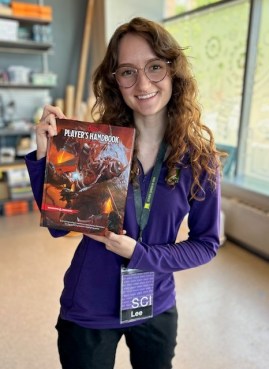 As we are approaching the 2023 Des Moines Mini Maker Faire, we wanted to learn more about Lee Adams and her passion for making as well as her interest in Dungeons and Dragons. We are excited for her to provide our participants with opportunities to explore the world of D&D and even participate in a mini campaign known as a One Shot.
Us: How would you define/ describe “making”?
Lee: I would say that “making” is the intentional act of creating something tangible. I think that making happens after inspiration and ideation, when someone has an idea that they can’t get out of their heads and has a plan to bring it to life. It’s the most active and hands-on part of the creative process.

Us: What were / are your areas of study?
Lee: I attended The University of Iowa and studied Studio Art, Psychology, and Writing because I was interested in so many things and couldn’t make up my mind. I’m glad that I learned and continue to learn about a variety of things– it helps you see the connections between everything. Those connections are what get me really excited!
Us: What got you interested in these fields?
Lee: I have always been a creative and a daydreamer, making up worlds and stories in my head when I didn’t have anything else to do (and sometimes when I did have other things to do– oops!) As a kid growing up with undiagnosed ADHD, I was forced to improvise when I missed something or wasn’t entirely sure what was going on. Strangely, I think that this actually increased my creative confidence and helped me utilize ingenuity as a secret weapon of sorts. I really relied on it academically, so it was only natural to go into something like art or writing. I think that my interest in psychology stemmed from my love of writing; I was constantly making characters and figuring out their motives, and I enjoy learning about how people’s brains work.
Us: What is your connection to The Science Center of Iowa?
Lee: I am a full-time employee and my position title is “Innovation Coordinator” which is exactly as fun as it sounds! I help with both the creation and the facilitation of our outreach events, working mainly with kids and teens to help them see how creativity can be useful in everything.

Us: What are some of your favorite maker activities?
Lee: I love it all. I love photography and painting and poetry and prose and gardening and journaling and cooking and– I think you get the point. My favorite activities are ones that weave together multiple disciplines. I think one of the best examples of this has to be Dungeons and Dragons (or D&D for short.) It may seem like just a silly little game, but it can overlap with almost any hobby or area of interest because, essentially, you are creating your own reality and there are no limitations to how far it can go.
For anyone who isn’t familiar with the game, I would describe it as co-creating a story with your friends who can either be a character (player) or the narrator (dungeon master or DM.) The DM’s job is to create a plot– typically fantasy or sci-fi related– that will be engaging and fun for their players. It’s also their job to know the lore and mechanics of the game, which involves a

lot of storytelling and math calculations. They make a setting and a plot that will entice their players to interact with it, and set up fun role-play and combat encounters with non-player characters (NPCs) and monsters to fight or befriend. Players talk as their characters a
nd inhabit the world that the DM has crafted, driving the story forward by rolling dice to see how successful their character is in their actions, sort of like an RPG video game, but in real life. The actions of the players can completely change the outcome of the story, which is why it’s so fun.
You can contribute to this game with nearly any hobby: drawing characters with your artistic skills, creating cosplays using fashion design, making stat blocks for a new monster using math, or even turning your campaign into the next best-selling novel by documenting it in writing. It’s a bottomless pit of fun and creativity and I would recommend it to anyone!
Us: Why do you think “making” is important?
Lee: As I implied above, I have a hard time with linear thinking. I used to see this as a bad thing because it caused me to struggle in areas like math and chemistry which were deemed “more important” than creative pursuits by society when I was growing up. As I got older and acquired more experience, however, I realized that nothing is mutually exclusive and that you can draw connections between anything. Creativity is not only present in every discipline– it’s necessary. When you allow your thoughts to meander about through the scenic route of your brain, you see lots of cool new things and discover solutions that you wouldn’t have found if you had floored it and sped down the highway to the quickest answer. Innovative thinking takes time and effort and intentionality. “Making” is not only a way to tangibly express this style of thought as an exercise for your brain’s creativity muscles, but it’s also a way to help those around you. Whether your creation is something as simple as a D&D oneshot that helps your friends unwind and have fun, or as life-changing as a cure for a terminal disease, everything you make is impactful to someone– even if it’s only yourself.
Des Moines Mini Maker Faire Call for Makers Application Open

The Des Moines Mini Maker Faire is now accepting exhibitor applications!
This years theme is “Let’s Get Making”.
Whether you’re a first-time tinkerer or an experienced inventor, Maker Faire welcomes a variety of creative projects, including:
- Crafts
- Fine Arts
- Robotics
- Technology
- Gaming
- Fashion design
- Woodworking
- 3D printing
- LEGO construction
- And more!
Exhibitor applications are due Friday, September 1 for the 2023 Des Moines Mini Maker Faire which is being held Monday, September 4 .
.
Light Up Your Halloween!

This Monday, September 5th, the Science Center of Iowa will be hosting the Des Moines Mini Maker Faire. Celeste Moreno, one of our Makers, will be welcoming creatives of all ages to a Mask Making Workshop, where they’ll have the chance to create a mask they can wear all day at the Maker Faire. There will be no additional cost for this workshop.
If you’d like to take your mask making skill to the next level, you can join our Advanced Mask Making Workshop. This activity, also hosted by Moreno, incorporates the use of LED lights and paper circuits.
“We’ll ‘level up’ and add some LED lights to our costume masks to create interesting visual effects,” said Moreno.
The Maker Faire is a great place for participants to design and manufacture their own inventive Halloween masks.
“Another possible outcome…is that they will make something that they can save and use for their Halloween costumes or develop the confidence to try making their own costume elements at home,” said Moreno about the possible take-aways from this event.
The advanced workshop charges an additional fee of $5 per person, a bargain compared to what you might pay for a Halloween costume this fall!
This activity is open to all ages. If you can easily use tools like scissors and tape, or have someone who can support you in the use of these tools, then you are a perfect fit for this activity. Children should be accompanied by an adult that can help facilitate their experience.
Mask Making Workshop:
Cost: $0
Open: 9:00 – 10:30 am
1:00 – 2:30 pm
Advanced Mask Making Workshop
Cost: $5
Open:
11:00 am – 12:00 pm Register here
3:00 – 4:00 pm Register here
Des Moines Mini Maker Faire Applications Open

The Des Moines Mini Maker Faire is now accepting exhibitor applications!
Whether you’re a first-time tinkerer or an experienced inventor, Maker Faire welcomes a variety of creative projects, including:
- Crafts
- Fine Arts
- Robotics
- Technology
- Gaming
- Fashion design
- Woodworking
- 3D printing
- LEGO construction
- And more!
Exhibitor applications are due Wednesday, August 31 for the 2022 Des Moines Mini Maker Faire which is being held Monday, September 5.